September 30, 2026
Research, Evaluation, and the Future of Housing + Health Integration
The evidence is clear: housing plays a critical role in health. Research from across the country continues to show that supportive housing helps people experiencing homelessness improve their health, access care, and avoid costly crisis. During a recent National Center for Housing + Health webinar, leading researchers discussed what we have learned from some of the nation’s most significant housing and health studies and what those findings mean for the future of homelessness prevention, supportive housing, and healthcare partnerships.
CSH’s Director, Strategy, Impact & Evaluation, Stephanie Mercier moderated a conversation with Sarah Gillespie of the Urban Institute, Sarah Hunter of RAND, and Dan Treglia of Rutgers University. While much of the discussion focused on supportive housing, the panelists also explored how healthcare and housing systems can work together to identify people at risk of homelessness earlier and connect them to support before a crisis occurs.
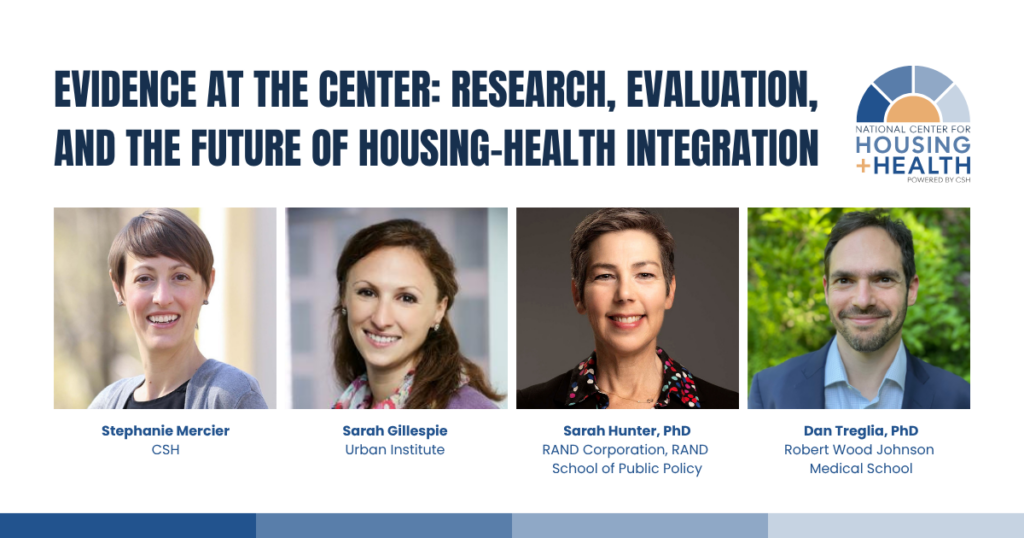
Missed the webinar? Watch the full recording of Evidence at the Center: Research, Evaluation, and the Future of Housing-Health Integration to hear directly from the researchers featured in this discussion.
What the Research Shows
Research from across the country continues to demonstrate how supportive housing improves health and healthcare access for people experiencing homelessness and other complex barriers to stable housing and health. Additionally, the research shows that when connected to stable housing, people use more integrated and preventative care services rather than costly emergency care.
Gillespie highlighted findings from Denver’s supportive housing research, where participants experienced fewer emergency department visits while increasing their use of outpatient care and prescription medications.
“When you have access to the right housing and the right services, you can shift that healthcare utilization and get the services folks need,” she said.
Hunter shared similar findings from studies in California and Arizona. Residents of supportive housing programs experienced reductions in emergency room visits and hospitalizations, along with increased use of preventive care and were better able to adhere to medication regimens.
As Hunter noted, “Stable housing is a foundation for better health.”
She also challenged a common question often posed about supportive housing: whether it saves money.
“We don’t ask whether chemotherapy or heart surgery saves money. We ask whether it saves lives and improves quality of life. And supportive housing does both of those things.”
While understanding costs remains important, the discussion underscored that improved health, stability, and quality of life are equally important outcomes.
Identifying Risk Earlier
Much of the existing research on housing and health focuses on people who are already experiencing homelessness. Increasingly, however, researchers are exploring how communities can identify and support people before they lose housing.
Treglia discussed work linking Medicaid and homelessness system data to better understand what happens in the months leading up to homelessness. Researchers are finding patterns that include increased hospitalizations, emergency department visits, and behavioral health service use.
The goal is to use that information to intervene earlier.
“How can we identify those folks in normative, non-homeless service settings so that we can address their needs earlier on?” Treglia asked.
The answer could help healthcare providers, managed care organizations, and policymakers develop more effective homelessness prevention strategies.
Evaluating Medicaid-Funded Housing Supports
As more states begin using Medicaid to cover housing-related services, researchers identified new opportunities to measure what works, improve program, and ensure public dollars are being used effectively.
In New Jersey, Treglia is helping evaluate the housing components of the state’s Section 1115 Medicaid waiver, including pre-tenancy supports, tenancy-sustaining services, move-in assistance, and housing-related modifications.
He emphasized that understanding whether a program works is only part of the equation.
“I’m a firm believer that any outcome evaluation should be accompanied by an implementation evaluation. If you know that something works or doesn’t work, you should know why it works or doesn’t work.”
That perspective resonated throughout the webinar. Factors such as provider capacity, partnerships, and data-sharing processes can all influence program success and are critical considerations for communities seeking to replicate promising models.
Adapting to Changing Needs
Several speakers noted that supportive housing programs must continue evolving as residents’ needs change over time.
Many residents are aging in place, while others are living with increasingly complex behavioral health needs that can affect housing stability and well-being. These realities require flexible service models that can adapt to changing circumstances.
One area receiving increased attention is making behavioral healthcare more accessible within supportive housing settings.
“What we’ve seen is when you provide that type of low-barrier care, that is easy for people to access, it can be really effective,” Hunter said.
Delivering services where people live can reduce barriers to care and make support easier to access when it is needed.
Gillespie also discussed research focused on people experiencing what she described as “high-acuity homelessness,” including individuals with significant behavioral health, medical and service needs.
Why Data Integration Matters
When asked what could most advance the field, the panelists repeatedly returned to one challenge: data integration.
Answering many of the field’s most pressing questions requires that housing, healthcare, Medicaid, and other public systems share information. Yet connecting those systems remains difficult.
Gillespie pointed to the need for stronger data infrastructure and greater collaboration across sectors.
“What are the strategies that can get to yes? What are the workarounds? What are the preconditions for being able to create the data infrastructure needed to do so much of this work we’re talking about?”
Better data sharing can help communities identify risks earlier, measure outcomes more effectively, and better understand which interventions are making a difference.
Defining Success Beyond Traditional Metrics
One of the most compelling parts of the discussion focused on what researchers have learned directly from supportive housing residents.
Administrative data can measure how frequently tenants engage in healthcare services , but it does not always capture what people value most in their daily lives.
Through interviews with residents, Gillespie and her colleagues found that many people defined recovery and well-being in terms of connection, purpose, and community involvement.
“What people most wanted in recovery was connection to community and a feeling that they were contributing to their community.”
Residents talked about working, volunteering, mentoring peers, and finding ways to give back. Those experiences often mattered just as much as traditional health measures.
The conversation served as an important reminder that research should continue to center the perspectives and priorities of the people supportive housing is designed to serve.
Key Takeaways
The webinar highlighted several areas shaping the future of housing and health research: homelessness prevention, aging in place, Medicaid-funded housing supports, low-barrier behavioral healthcare, and new approaches for people with complex needs.
Despite the wide range of topics, the panelists shared a common conclusion.
As Gillespie noted, “We know people need housing and services.”
The evidence connecting housing and health continues to grow. The challenge now is turning that evidence into action through stronger partnerships, better data, and expanded access to housing and supportive services.
Continue the Conversation
This webinar is part of the National Center for Housing + Health’s Crossing Perspectives series. Visit our Events page to explore past conversations and upcoming events.
Evidence at the Center is a forthcoming blog series highlighting new and emerging evidence at the intersection of housing and healthcare. Have an idea for a future post? Reach out to Stephanie Mercier and share your suggestions.
Share on Social
Related Posts

July 28, 2026
CSH analyzes the June 1 CMS guidance on Medicaid work requirements.

June 29, 2026
Key Takeaways from Our First Thought Leadership Conversation

June 25, 2026
Recent federal legislation (H.R.1) introduces significant changes to SNAP, including reduced funding, stricter eligibility rules, and expanded work requirements.