June 29, 2026
Where Housing Meets Health: What It Will Take to Align Systems
Key Takeaways from Our First Thought Leadership Conversation
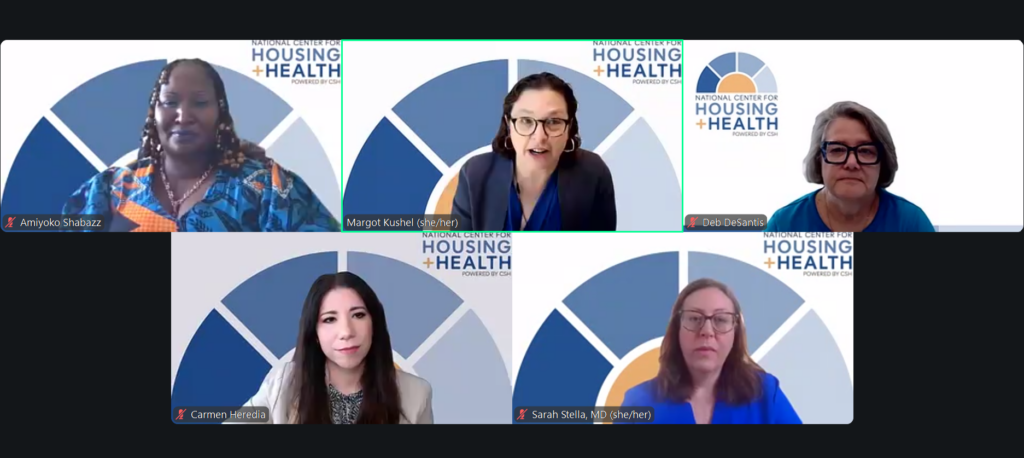
The launch of the National Center for Housing + Health’s new thought leadership series, “Crossing Perspectives,” brought together leaders across housing, healthcare, behavioral health, and lived experience to explore one urgent question:
What will it take to truly align systems to meet the needs of people with complex health and housing challenges?
This is a pivotal moment. Systems are shifting, needs are deepening, and shrinking federal healthcare funding is making stronger alignment, deeper partnership, and a renewed commitment to people-centered solutions essential.
As Health Needs Grow More Complex, Systems Fall Short
Across the panel, speakers underscored a shared reality: people experiencing homelessness today are facing complexity, acuity, and unmet needs more than ever before.
Dr. Margot Kushel, director of the UCSF Benioff Homelessness and Housing Initiative & Action Research Center for Health, shared an urgent and important insight from her work. “People experiencing homelessness and those living in supportive housing are actually sicker than they were a decade ago.”
That shift shows up in both data and lived reality. “We’re seeing many more complex chronic disease conditions, many more early onset of what we usually think of as aging related conditions,” said Dr. Kushel. “So, more people living with dementias, living with functional deficits, people experiencing homelessness or in supportive housing with conditions like cancer and congestive heart disease that really require an integrated housing and health response.”
On the front lines of care, Dr. Sarah Stella, director of Housing Outreach, Partnerships and Engagement (HOPE) at Denver Health and professor of medicine at the University of Colorado School of Medicine, sees the same trend every day. “About one in five of the patients that I treat in the hospital are experiencing literal homelessness.”
Even more striking, “About 60% of them actually have some sort of serious functional impairment… that interferes with their ability to access both housing and healthcare services,” Dr. Stella said.
The result is a system increasingly stretched, where unmet needs escalate into higher acuity, longer hospitalizations, and more costly interventions.
Policy Momentum is Real, But Not Enough
While challenges are growing, so too is momentum.
Carmen Heredia, president & owner of Sonora Strategy Partners and former Arizona Medicaid director who oversaw care for more than 2.5 million residents, highlighted a major shift: housing is increasingly recognized not just as a social need, but as a healthcare imperative.
“We’ve been working on housing as a healthcare issue for over a decade,” she said. “And the 1115 waiver authority is now proven, not just theoretical.”
Across the country, Medicaid programs are beginning to play a meaningful role in housing stability. “Medicaid is now being seen as a potential space to be able to intervene with housing issues…for navigation, tenancy support, and moving costs,” she said.
Importantly, the framing is shifting, not just as a moral imperative, but as a financial one. “Managed care organizations are starting to see housing as a real financial issue, not just as a values issue,” said Heredia. But this progress has limits. “Medicaid dollars aren’t really solving the housing shortage problem.”
And without broader investment, policy innovation alone cannot meet the scale of need.
The Biggest Gap Isn’t Services, It’s Trust
While much of the conversation focused on systems, one of the most powerful insights came from Amiyoko A. Shabazz, a lived experience community leader and joy and play practitioner, who brought a lived experience perspective to the discussion. “I see a major disconnect between systems… and what people actually experience,” she said.
She challenged the field to look beyond policy and infrastructure to something more fundamental: trust between supportive housing tenants and their service providers. “The gap comes down to trust… even when services are available,” said Shabazz. Without that trust, systems fail to reach the people they’re designed to support. “People are not receiving the services… and therefore they’re not thriving in their housing.”
Shabazz said the solution isn’t structural; it’s relational. “The real shift we need is from process-centered systems to relationship-centered systems.”
The Critical Role of Data and Partnership
Across perspectives, one theme emerged repeatedly: alignment requires shared data and shared accountability.
As Carmen Heredia put it, “you can’t align what you can’t see.”
From state-level systems to local models, data integration is essential not only for understanding needs, but for targeting interventions and demonstrating impact.
At the same time, partnership is the vehicle that brings alignment to life. Dr. Stella emphasized the need to move beyond silos. “Partnerships are key, and we’re going to have to get outside of our comfort zones,” she said.
In Denver and elsewhere, emerging models are showing how health systems, housing providers, and public agencies can work together, particularly when supported by shared data and coordinated funding.
Peers and Lived Experience: Bridging the Gap
The conversation also highlighted the critical role of peer support and lived expertise in bridging system gaps.
Shabazz shared a powerful example of how peer support can change outcomes in real time, describing a moment when a community member had relapsed, and others hadn’t noticed. A peer specialist, drawing on their own lived experience, recognized the signs immediately, approached her with empathy, and helped guide her back to recovery. “It is important that we use peer specialists… to fill the gaps,” she said.
These moments, often invisible in traditional systems, are where trust is built, crises are prevented, and long-term stability becomes possible.
But too often, these voices are underrepresented in system design. “Start with inviting the person to the table and treat them with dignity and respect,” said Shabazz.
A Critical Moment Ahead
As the conversation turned to the future, speakers expressed both optimism and concern.
There is real progress to build on, but also significant risk. Dr. Kushel warned, “we’re facing real threats to what we know works that could really turn us backwards.”
From Medicaid policy changes to funding cuts, the field is entering a period of uncertainty that could reshape the landscape.
At the same time, Dr. Stella offered a call to action. “We don’t need to feel alone in this work… this is something lots of people are struggling with,” she said. “I want to encourage us not to despair.”
What Comes Next
Despite the challenges, the path forward is clear:
- Deepen cross-sector partnerships at every level
- Invest in data systems that enable coordination and accountability
- Center lived experience in design and decision-making
- Align funding models with real-world needs
- Build systems that are not just coordinated, but human-centered
As moderator Deborah De Santis, president and CEO of Corporation for Supportive Housing, reflected in closing, no single system can solve these challenges alone. Progress depends on collective action and shared responsibility.
As Shabazz put it, “Call me to the table. I’m coming.”
Continuing the Conversation
This session marks just the beginning.
The Crossing Perspectives series will continue to explore critical topics including research and evidence, financing and Medicaid, community-based care, and data integration, each essential to building a more aligned and effective system.
Share on Social
Related Posts

September 30, 2026
A conversation on research and the future of housing + health

July 28, 2026
CSH analyzes the June 1 CMS guidance on Medicaid work requirements.

June 25, 2026
Recent federal legislation (H.R.1) introduces significant changes to SNAP, including reduced funding, stricter eligibility rules, and expanded work requirements.